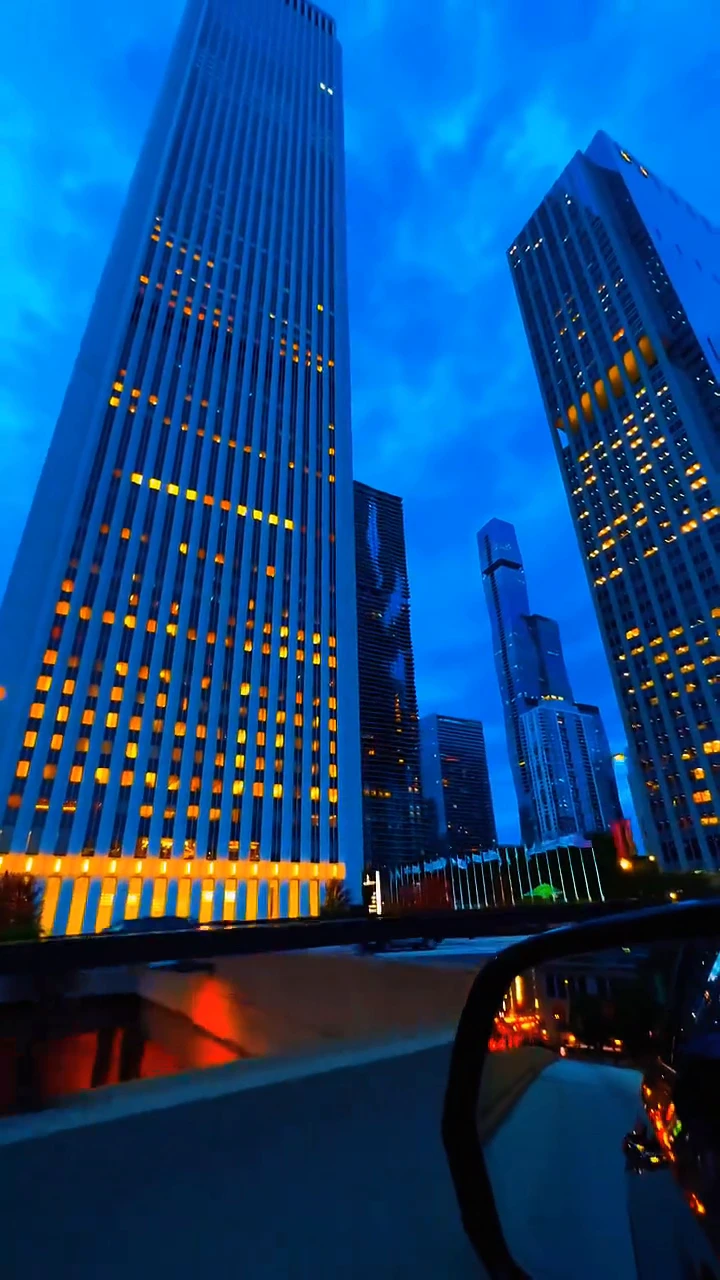
From fishing village to the world's fastest-built megacity
In 1979, Shenzhen was a town of 30,000 people. Forty-five years later, it is a metropolis of 18 million - the fastest urban growth in recorded human history. Designated China's first Special Economic Zone (SEZ) in 1980, it became the laboratory where the Chinese Communist Party tested capitalism at full speed.
The result is not just a big city. It's a living proof-of-concept that cities can be deliberately designed to generate innovation at scale.
"Shenzhen is not a city that happened to become innovative. It's a city that was architecturally programmed to be."
The architecture of disruption
What makes the viral video so striking is the density of architectural ambition per square kilometer. Shenzhen hosts some of the world's most audacious towers: the Ping An Finance Centre (592m, 4th tallest globally), the twisted steel of the Shenzhen Stock Exchange by OMA, and the crystalline geometry of the China Resources HQ. These aren't just tall buildings - they're physical declarations of technological ambition.
Urban planners call this "innovation morphology" - the idea that the physical form of a city can either accelerate or suppress creative output. Shenzhen has optimized for speed, density, and collision: the chance encounters between engineers, manufacturers, designers, and capital that produce new things.
The speed of Shenzhen as an urban innovation metric
In innovation research, we talk about "TRL" - Technology Readiness Level. Shenzhen has developed its own equivalent: an urban infrastructure that compresses the distance between idea and product to near zero. The Huaqiangbei electronics district contains more hardware component density per square meter than any place on Earth. A startup can walk in with a sketch and walk out with prototypes the same week.
This is what the viral video captures, even if viewers don't name it: the built expression of a system that was designed to move fast. The towers are not decorative. They are the physical manifest of a compounded annual growth rate in innovation output.
What other cities can learn from Shenzhen
The Shenzhen model - SEZ designation, massive infrastructure investment, talent immigration policy, and deliberate clustering of supply chain and capital - has been studied by Singapore, Dubai, Nairobi, and Riyadh. Each is attempting to replicate a version of the "innovation city" experiment at different scales and contexts.
But the deeper lesson from Shenzhen is one of intentionality. The city did not become a global innovation hub by accident. It was the product of a specific theory of urban development, executed at national scale. The skyline that looks like an alien city is the most honest possible rendering of that theory in three dimensions.